What Is Lyophilization? Why Every Research Peptide Is Freeze‑Dried

Updated: 12 hours ago
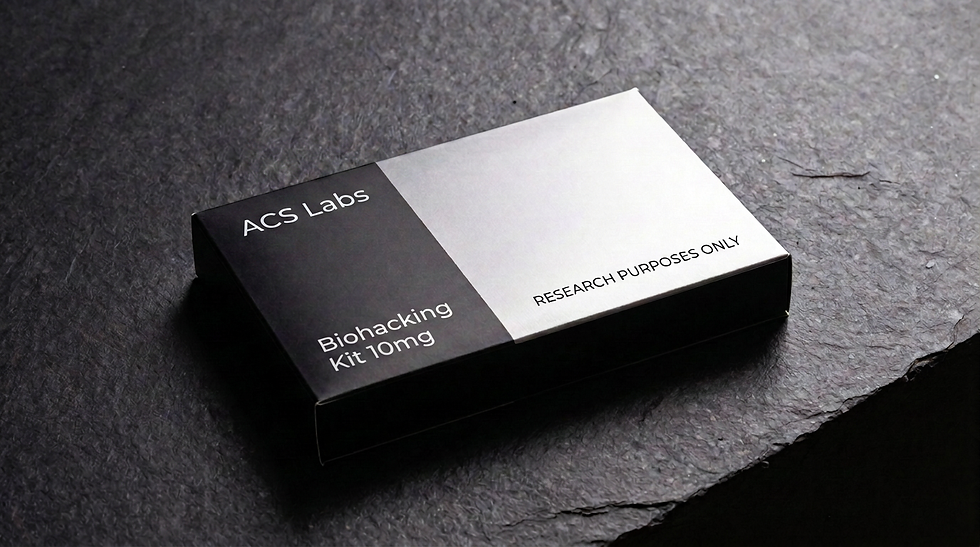
Lyophilization, or freeze‑drying, is the gold standard for research peptide storage. This guide explains how it works, why every serious supplier uses it, and what it means for handling and storing your vials in the lab.
If you’ve ever looked at a research peptide listing, you’ve seen the phrase “lyophilized powder.” Every peptide sold by Ramos Method — and virtually every other serious supplier — arrives in this form.
But what exactly is lyophilization, why is it the gold standard for peptide storage, and what does it mean for how you handle your vials in the lab?
What Is Lyophilization?
Lyophilization — more commonly known as freeze‑drying — is a dehydration process that removes water while preserving a compound’s structure and biological activity.
In simple terms, it happens in three main steps:
1. Freezing
The peptide solution is cooled to very low temperatures, typically below −40°C, until all the water turns to ice.
2. Primary drying (sublimation)
The surrounding pressure is reduced and gentle heat is applied. Instead of melting, the ice skips the liquid phase and goes straight from solid to vapor. This is called sublimation.
3. Secondary drying
Any remaining bound moisture is removed at slightly higher temperatures, leaving the peptide as a dry solid.
The end result is a dry, porous powder or “cake” that keeps the molecular structure of the original peptide intact. This powder is sealed in a glass vial under vacuum or inert gas and can be stored for extended periods with minimal degradation.
Why Peptides Need To Be Lyophilized
Peptides are inherently unstable in solution. Once dissolved in water, several degradation pathways start to work against them:
Hydrolysis – water molecules slowly break peptide bonds.
Oxidation – especially in peptides containing methionine or cysteine.
Microbial growth – bacteria and other microbes can grow in aqueous solutions.
Aggregation – peptide molecules can clump together and lose activity.
Lyophilization dramatically slows or eliminates these issues:
With no water present, hydrolysis can’t occur.
Sealed vials with minimal oxygen reduce oxidation.
The absence of liquid prevents microbial growth.
The solid state limits molecular motion and aggregation.
This is why reputable research peptide suppliers ship products as lyophilized powders instead of pre‑mixed solutions.
What a Properly Lyophilized Peptide Looks Like
A well‑lyophilized peptide usually appears as:
A white to off‑white powder, or
A compact “cake” or “puck” at the bottom of the vial.
Appearance can vary. Some peptides form a fluffy, loose powder; others form a more solid disc. Both are normal.
Red flags to watch for:
The peptide looks wet or sticky.
The powder is discolored (yellow, brown, etc.).
There are visible particles that don’t dissolve when you reconstitute.
Any of these may indicate degradation, contamination, or poor lyophilization.
Reconstitution: Bringing the Peptide Back Into Solution
Before use in a lab setting, lyophilized peptides must be reconstituted — dissolved back into solution.
The standard solvent is bacteriostatic water, which contains 0.9% benzyl alcohol as a preservative to help inhibit bacterial growth.
Best practices for reconstitution:
Add solvent slowly
Drip the bacteriostatic water down the side of the vial rather than directly onto the peptide cake.
Let it dissolve naturally
Avoid vigorous shaking. This can cause foaming and may stress the peptide. Gentle swirling is fine if needed.
Treat the clock as “started”
Once the peptide is back in solution, degradation processes resume. Bacteriostatic water extends the usable window compared to sterile water, but it doesn’t stop degradation entirely.
Reconstituted peptides should be stored at 2–8°C and used within a reasonable timeframe.
Storage: Before and After Reconstitution
Before reconstitution (lyophilized form):
Store at 2–8°C for short‑ to medium‑term storage.
Store at −20°C for long‑term storage.
Protect from light and moisture.
In this state, most peptides remain stable for months to years, depending on the sequence and conditions.
After reconstitution (in solution):
Store at 2–8°C.
When reconstituted with bacteriostatic water, use within 28 days.
Do not freeze reconstituted peptides — freeze–thaw cycles can damage peptide structure.
For a deeper dive into storage specifics, see your full guide: “Peptide Storage Guide: How to Keep Your Research Peptides Stable.”
Why Lyophilization Quality Matters
Not all lyophilization is equal. Poorly executed freeze‑drying can:
Leave too much residual moisture, shortening shelf life.
Lead to partial degradation before the vial even reaches the lab.
Allow air and humidity into the vial if sealing is not done correctly.
This is one of the key reasons sourcing from suppliers who work with established cGMP manufacturers matters. Proper lyophilization requires controlled equipment, validated processes, and consistent quality checks.
At Ramos Method, all products are sourced from established manufacturers and verified through independent ACS Labs analytical testing. That way, when you see “lyophilized powder” on a vial, you know the process behind it is designed to protect peptide integrity from production to your lab bench.


Comments